Best DPDP-Compliant eConsent Platforms & Consent Management Systems in India
Reviewed by Clinical Compliance Advisory Team
Key Takeaways
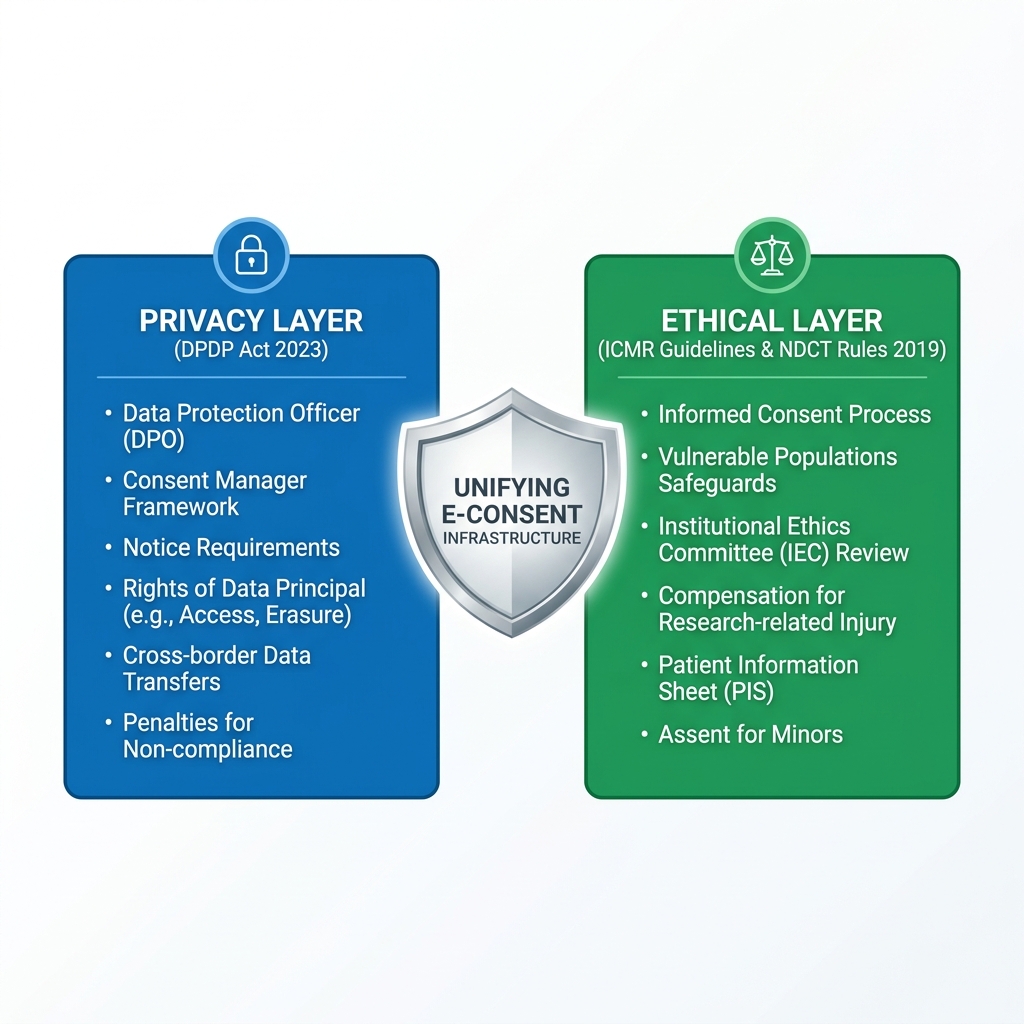
- Dual Compliance Framework: Healthcare institutions and sponsors operating in India must run parallel compliance paths: the ethical layer governed by ICMR and NDCT Rules 2019, and the privacy layer governed by the DPDP Act 2023.
- Language Localization: Section 5(1) mandates that consent notices and authorization forms must be offered in English or any of the 22 regional Indian languages listed in the Eighth Schedule.
- Legacy Data Re-Noticing: Under Section 5(2), fiduciaries must issue updated, DPDP-compliant consent notices to existing patients and research participants who provided authorization prior to the enactment of the law.
- Infrastructure vs. Consent Managers: Registered Consent Managers act as unified user-facing agents, whereas platforms like ConsentCollect provide the underlying secure data processing infrastructure that enables hospitals to execute compliant consent workflows.
- Frictionless Control: Compliance requires that withdrawing consent must be as easy as providing it, backed by verifiable audit trails and robust data erasure protocols.
India's data protection ecosystem underwent a fundamental transformation with the passage of the Digital Personal Data Protection (DPDP) Act, 2023. This law establishes a strict privacy framework that directly affects how healthcare providers, clinical research organizations, and digital health platforms collect, process, and manage personal data.
For medical clinics and clinical trial sponsors, consent is not simply a check-the-box administrative task. It is a core legal and ethical requirement. Operating in compliance with the DPDP Act requires transitioning away from traditional paper-based clipboards and basic digital signatures toward structured, multi-lingual consent management systems. This guide reviews the requirements of the DPDP Act, details its intersection with clinical research guidelines, compares the best DPDP-compliant eConsent platforms, and outlines how organizations can achieve compliant-by-default workflows.
#1. The Legal Framework: India's DPDP Act, 2023 and Consent
The DPDP Act places the Data Principal (the patient or clinical trial subject) at the center of the regulatory framework. Under the Act, any entity processing personal data is designated as a Data Fiduciary (the hospital, clinic, or sponsor) and must adhere to strict guidelines regarding user authorization.
#The Standard of Valid Consent
Under Section 6 of the DPDP Act, consent must satisfy five cumulative criteria to be recognized as legally valid:
- Free: The patient must not be coerced, misled, or forced into providing authorization.
- Specific: Consent must be requested for a clearly defined processing purpose. Senders cannot bundle unrelated processing activities together under a single signature.
- Informed: Senders must precede or accompany the request with a detailed consent notice.
- Unconditional: Sponsors cannot condition the provision of a medical service on consent for processing unnecessary personal data.
- Unambiguous: The patient must provide consent through a clear, affirmative action. Silent agreements, pre-ticked checkboxes, and inactivity are legally void.
#The Mandatory Consent Notice
Section 5(1) of the Act mandates that every request for consent must be accompanied or preceded by a separate, clear notice. Senders must write this notice in plain language. The notice must specify:
- The precise categories of personal data being collected.
- The specific purpose for which the data will be processed.
- The process by which the patient can exercise their rights, including the right to withdraw consent.
- The grievance redressal pathway to report complaints to the Data Protection Board of India (DPBI).
#The Eighth Schedule Language Requirement
One of the most logistically complex requirements of the DPDP Act is language accessibility. The Act requires that the consent notice and the authorization form must be made available in English or any of the 22 regional languages specified in the Eighth Schedule to the Constitution of India (such as Hindi, Bengali, Tamil, Telugu, Marathi, Gujarati, and Kannada). Senders must allow the patient to choose their preferred regional language during the consent transaction. Senders must ensure the translation is accurate and easily understandable by laypeople.
#2. The Intersection of Privacy and Clinical Ethics: ICMR and NDCT 2019
Hospitals and clinical trial sponsors in India do not operate solely under the DPDP Act. Clinical data collection must run parallel to existing healthcare regulations. Senders must distinguish between the ethical requirements of clinical procedures and the privacy requirements of data processing.
#The Dual Regulatory Standards
- The Ethical and Procedural Layer: Governed by the Indian Council of Medical Research (ICMR) National Ethical Guidelines and the New Drugs and Clinical Trials (NDCT) Rules, 2019. These guidelines dictate what clinical information must be disclosed (such as trial procedures, medical benefits, and drug risks), mandate audio-visual recording of informed consent for specific high-risk trials, and require Institutional Review Board (IRB) review of all consent documents.
- The Privacy and Data Protection Layer: Governed by the DPDP Act, 2023. This law regulates how the digital data collected during the consent process (such as patient identifiers, signature files, telemetry logs, and video recordings) is stored, secured, shared with third-party processors, and ultimately deleted.
A compliant eConsent platform must solve both standards simultaneously. The system must deliver the IRB-approved clinical disclosures required by ICMR while enforcing the multi-lingual notices, active opt-ins, and data security measures mandated by the DPDP Act.
#3. Anatomy of a Compliant DPDP Consent Workflow
Designing a compliant digital workflow requires incorporating several technical controls into the patient intake or clinical trial onboarding interface.
#Section 5(2) Legacy Re-Noticing
A major administrative challenge for ongoing, multi-year clinical trials and long-term hospital registries is the management of historical data. Under Section 5(2) of the DPDP Act, if a patient provided consent prior to the enactment of the law, the Data Fiduciary must send them a modernized, DPDP-compliant notice in their preferred regional language as soon as reasonably practicable. This notice must retroactively explain what data is held, the purpose of processing, and how the patient can withdraw consent. Managing this re-noticing process is critical for maintaining the legal validity of historical databases.
#Verifiable Parental Consent for Minors
Section 9 of the DPDP Act enforces strict protections for children (defined as individuals under 18 years of age) and persons with disabilities under guardianship. Senders must obtain verifiable consent from a parent or legal guardian before processing any personal data. Furthermore, fiduciaries are prohibited from:
- Processing personal data that is likely to cause an detrimental effect on the well-being of a child.
- Tracking, behavioral monitoring, or profiling children.
- Targeting advertisements or marketing materials at children.
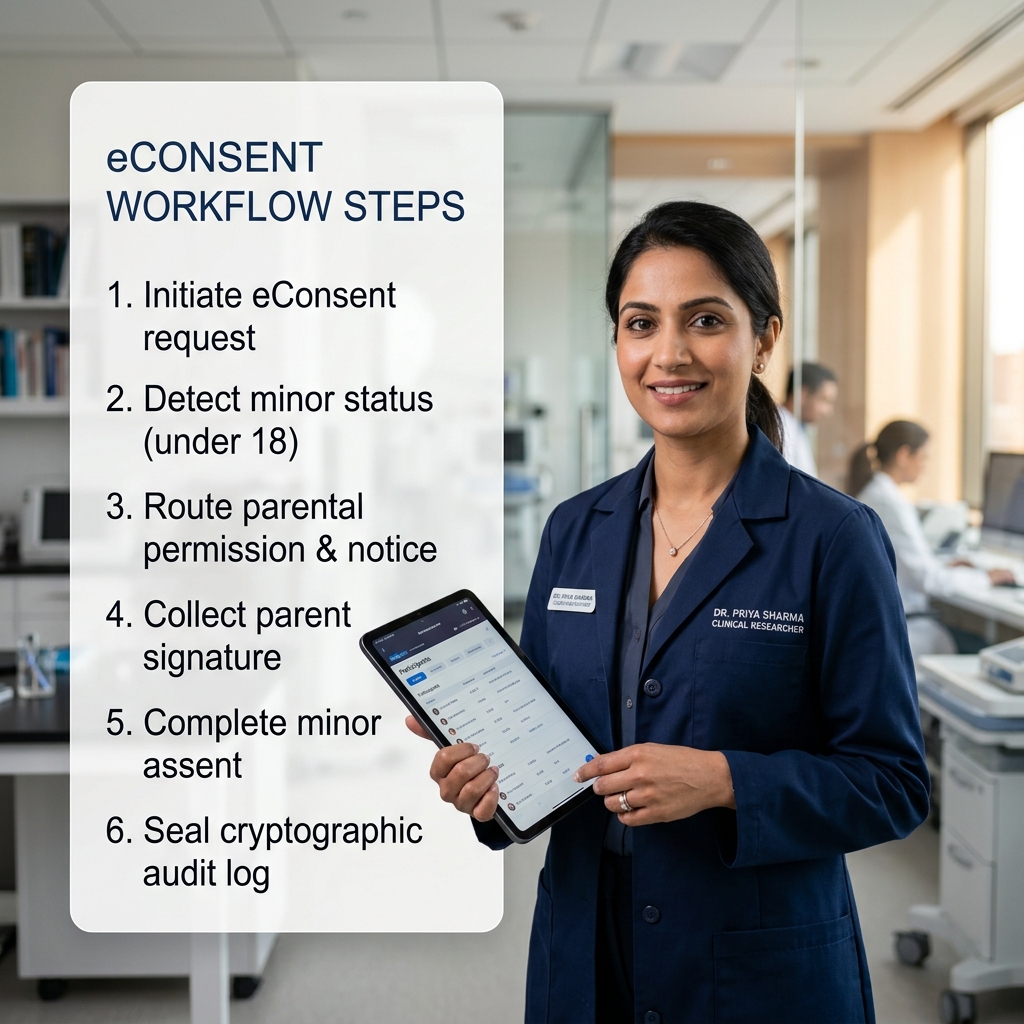
A compliant eConsent system must support sequential signatory routing. When a minor is enrolled, the system must direct the consent workflow to the parent or guardian first. Senders must verify the guardian's identity, collect their digital signature, and block any subsequent tracking scripts or marketing triggers on the patient's record.
#Section 7: Medical Emergencies and "Break-Glass" Overrides
The DPDP Act recognizes that strict consent gates cannot block life-saving medical care. Section 7 of the Act establishes "legitimate uses" where personal data can be processed without explicit consent. This exemption covers:
- Medical emergencies involving a threat to the life or immediate severe threat to the health of the Data Principal or another individual.
- Providing medical treatment or health services during an epidemic, outbreak, or public health emergency.
- Executing search and rescue operations during disasters.
For electronic document workflows, clinics must utilize platforms that support a secure, audit-logged "break-glass" clinician override. If a patient is incapacitated, a treating physician can bypass the standard signature requirement to access and process clinical records. Senders must configure the system to record the clinician's identity, the precise timestamp, and the medical justification in a tamper-evident audit log, ensuring accountability under subsequent administrative reviews.
#Frictionless Consent Withdrawal
The DPDP Act dictates that withdrawing consent must be as simple as providing it. If a patient can authorize a procedure in one click on a mobile screen, they must be able to revoke that authorization with equal ease. Senders must provide a secure, self-service digital interface where patients can review their active consents and submit withdrawal requests. Senders must process these requests promptly, triggering automated notifications to all integrated downstream systems (such as Electronic Health Records and third-party laboratories) to halt processing and execute data erasure protocols.
#4. The Legal Role: Registered Consent Managers vs. eConsent Infrastructure
There is significant confusion regarding the role of a "Consent Manager" under the DPDP Act. Senders must distinguish between the role of the legal entity defined by the Act and the software infrastructure used to collect consent.
#The Registered Consent Manager
Under Section 6(7), a Consent Manager is a specialized legal entity registered with the Data Protection Board of India. It acts on behalf of the Data Principal (the citizen). The Consent Manager provides a single, unified digital interface (often a mobile application) where a citizen can view, give, manage, review, and withdraw their consent across multiple different businesses, hospitals, and service providers. Senders can think of a Consent Manager as a central privacy agent representing the user.
#Consent Management Infrastructure (Data Processor)
In contrast, platforms like ConsentCollect, Consent-in by Leegality, and Privy by IDfy operate as Consent Management Infrastructure. These platforms do not act as independent agents representing the citizen. Instead, they are software-as-a-service (SaaS) tools and secure data processors utilized by the Data Fiduciary (the hospital, clinic, or sponsor).
The software enables the hospital to host the consent forms, translate the notices into the 22 regional languages, run sequential signature routing, secure the audit logs, and synchronize the completed documents with internal Electronic Health Record (EHR) systems. Senders must understand that using a compliant consent platform empowers the fiduciary to meet its legal obligations directly.
#5. Best DPDP-Compliant eConsent Platforms & Consent Management Systems in India
When selecting a consent management system, healthcare organizations and trial sponsors must evaluate platforms based on their ability to handle clinical workflows, multi-lingual notice delivery, parent/guardian routing, and secure audit tracking.
#1. ConsentCollect
ConsentCollect is a specialized, compliant-by-default eConsent and document builder platform built specifically for healthcare and clinical research environments.
- Eighth Schedule Translation: Out-of-the-box support for the 22 official languages of India. Templates can be authored in multiple regional translations, allowing patients to switch languages instantly.
- Clinical Protocol Version Control: Allows sponsors to update consent templates as clinical protocols evolve, triggering automated re-consenting workflows for active patients.
- Minor & Guardian Routing: Enforces verifiable parental consent by routing documents sequentially through parent validation gates.
- Audit-Logged Break-Glass Override: Supports Section 7 medical emergency overrides, logging clinician access parameters cryptographically.
- Burden of Proof Audits: Generates tamper-evident PDF records and cryptographic audit logs documenting notice delivery, reading duration, and OTP-verified signatures.
#2. Consent-in by Leegality
Consent-in by Leegality is a compliance utility designed for DPDP consent management in the Indian market.
- Consent Lifecycle Management: Built to manage the complete consent lifecycle, from notice distribution to user rights and data deletion.
- Indian Signature Ecosystem: Integrates with local e-sign and digital verification frameworks to help corporate fiduciaries manage audit logs.
- Limitations in Clinical Settings: Lacks clinical trial specific features, multi-party sequential signature workflows (Patient, Witness, Clinician), and healthcare data standards integrations such as FHIR R4.
#3. Privy by IDfy
Privy by IDfy is a dedicated DPDP compliance and privacy governance suite for Indian enterprises.
- Granular Consent Notices: Supports managing itemized consent notices and generating secure, hash-verified consent logs.
- AI-Assisted Compliance: Includes features like RoPA automation, vendor management, and an AI compliance copilot (Inspect AI).
- Limitations in Clinical Settings: Designed primarily as a corporate registry and data mapping tool. Lacks specialized clinical template editors, patient intake builders, and "break-glass" emergency medical override workflows.
#6. Comparison Table: Indian CMPs vs. Specialized eConsent
Review the table below to compare the capabilities of general Indian consent management systems against specialized eConsent platforms:
| Feature / Criteria | Indian CMPs (Privy by IDfy / Consent-in) | Specialized eConsent (ConsentCollect) |
|---|---|---|
| Primary Use Case | Corporate consent logs, privacy compliance audits | Surgical consent, patient intake, clinical trials |
| Clinical Protocol Updates | Manual updates across custom corporate data maps | Native version control with re-consenting triggers |
| Multi-Party Signatures | Primarily single-user consent tracking | Sequential signature routing (Patient, Parent, Clinician, Witness) |
| Emergency Break-Glass | Not supported | Audit-logged clinician override for Section 7 scenarios |
| Eighth Schedule Support | Multi-lingual notice registries | Out-of-the-box regional language toggles |
| Auditable Burden of Proof | Cryptographic hashes (SHA-256) | Cryptographic, tamper-evident forensic timestamps |
| Healthcare Integrations | Lacks native medical integrations | Supporting FHIR R4 APIs and secure EHR links |
#7. Implementing a Compliant Workflow with ConsentCollect
Transitioning to a DPDP-compliant system does not require rebuilding your clinical IT stack. ConsentCollect provides the developer tools and pre-configured templates to achieve compliance quickly.
#Risk-Free Sandbox Testing
Developers, compliance officers, and clinical coordinators can evaluate the entire consent lifecycle using the ConsentCollect Sandbox Tier. The sandbox allows teams to:
- Create custom consent notices under Section 5.
- Test regional translation routing rules across the 22 Eighth Schedule languages.
- Configure sequential signature routing for minor patient onboarding.
- Validate webhook payloads, FHIR API endpoints, and PDF generation tools without inputting a credit card.
#8. Regulatory FAQ Section
#What are the penalties for non-compliance under the DPDP Act?
The DPDP Act establishes significant financial penalties to enforce compliance. The Data Protection Board of India (DPBI) can levy fines based on the severity of the violation:
- Failing to prevent personal data breaches: Penalties up to ₹250 crore (approximately $30 million USD).
- Violating obligations regarding child data (Section 9): Penalties up to ₹200 crore.
- Failing to fulfill obligations to Data Principals: Penalties up to ₹150 crore.
These substantial penalties make the selection of a secure, compliant consent platform a critical risk-management decision for healthcare executives.
#Does the DPDP Act of 2023 classify health data differently?
Unlike previous legislative drafts (and regulations like Europe's GDPR), the finalized DPDP Act, 2023 does not create separate categories of personal data, such as "Sensitive Personal Data" or "Special Category Data." All digital personal data is governed under the same standard.
However, medical and health records remain subject to strict sectoral regulations in India, including the Ministry of Health and Family Welfare guidelines, the draft Digital Information Security in Healthcare Act (DISHA), and the National Digital Health Mission (NDHM) sandbox rules. Healthcare providers must ensure their consent management systems satisfy both general DPDP rules and these specialized clinical requirements.
#Are digital signatures on consent forms legally binding for clinical trials in India?
Yes, digital signatures are legally binding for clinical trials in India under the Information Technology Act, 2000, provided they meet the standards of security and authentication. Senders must ensure the signature is uniquely linked to the signatory, is under the sole control of the signer, and is accompanied by a tamper-evident audit trail that detects any subsequent alterations to the document.
Additionally, clinical trials must comply with the specific informed consent guidelines (including audio-visual recording where mandated) under the New Drugs and Clinical Trials Rules, 2019 and the ICMR Guidelines.
Related Insights & Guides
Stay compliant and optimize your workflows with guidance from clinical operations and legal experts.
Best eConsent Platforms for Dental & Oral Surgery: 2026 Comparison
Compare the best eConsent and patient intake software for dental practices and oral surgery clinics. Evaluate ConsentCollect, mConsent, Dental Consent Cloud, and Smile Consent UK.
Best eConsent Platforms for Plastic Surgery: 2026 Comparison
Compare the best eConsent and patient intake software for plastic surgery practices. Evaluate ConsentCollect, DocuSign, Nextech, and Symplast on 10 critical cosmetic consent pain points.
Patient Consent Management Platforms: Healthcare & Clinical Trial Guide
An expert guide to patient consent management platforms (CMPs) in healthcare and clinical trials. Compare ConsentCollect, Veeva, Medidata, Castor, and REDCap to select the best system for your compliance, EHR, and database needs.